
Strategic Strengthening of Business Ties in Hard Times: Investing in the “Next Day”
Aligning Israeli-Greek Business Ventures with National Strategy and Global Geopolitical Shifts

Konstantinos Petoumenos*
– Introduction: Embracing Long-Term Business Strategy in a Shifting Global Landscape
In this radically transforming period, policymakers and businesses must take into serious consideration that globalization context has altered from the recent past. Mainstream (geo)political trend requires the alignment of strategies with core national interests and evolving international geopolitical realities.
Entrepreneurs who take a forward-looking, strategic approach – understanding that national security concerns and massive power shifts will shape future opportunities will not only survive but thrive in the “Next Day” – the reshaped new global order that will follow the current tectonic shifts. By contrast, those who disregard massive developments through outdated lenses risk being blindsided by the new era.
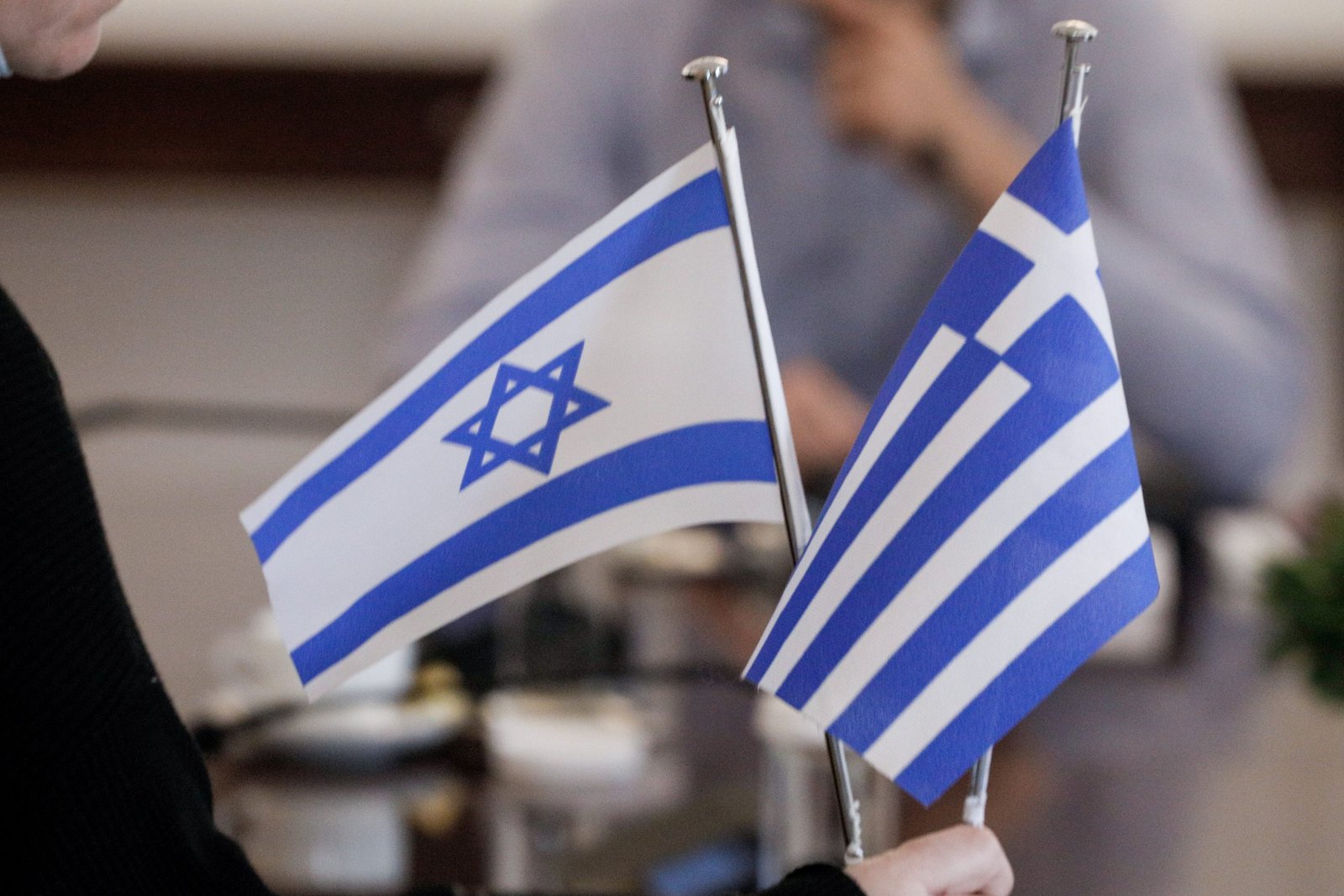
Focusing on Israeli and Greek entrepreneurship, an obvious key area they can capitalize is through strengthened partnerships between them, as a prime example of how businesses – by aligning with the geopolitical shifts and major actors’ planning – can gain significant advantages, with an emphasis in defense and security sector, innovation, technology and sustainable development.
Although these countries already cooperate on key economic and security matters, there is significant room for deeper business ties across all sectors.
In this context, among other energy and trade projects, the US designed India-Middle East-Europe Corridor (IMEC) provides an avenue for Israel and Greece to assert their strategic business relations and regional power aligned with the US strategy, to also strengthen ties with India and, concurrently, to boost substantial cooperation with leading countries in the Arab world, such as Saudi Arabia and Egypt.
In general, a fundamental principle to mitigate risks and pave the way to success is to comprehend that the present historic moment is not the ideal one.
This is a hard-core era where both policy and business leaders must be strong, act decisively and make clear strategic choices. Ambiguous policies and vague business choices belong to past decades, whilst unclear positioning and lack of strategic mindset not only put at risk long-term vital interests and undermine strategic partnerships, but also reflect weakness – a fatal feature to have in politics, geopolitics and entrepreneurship.
Besides, history has proved that global system and business world show respect to and reward only decisive, ingenious and adaptive leaders.
– The International Geopolitical Context: Understanding Shifting Power Dynamics – The Battle through Global Trade Routes
To create effective business planning, it is essential to comprehend the broader geopolitical dynamics and the profound impact that global shifts in power balance will have on their success.
To this end, a reasonable perspective to approach and analyze current international conditions is the official US Defense and Security doctrine that names as the major national threat for US, China’s growing ability and intent to reshape the international order.
In fact, said US national strategy – followed by successive US administrations – mirrors the international geopolitical competition between the US-led “traditional block” and the China-led “revisionist block” – mainly consisted of China, Russia, Iran, Turkey – that aims to challenge current global order and establish a new power balance status quo. It is worth noting though that overlapping and conflicting long-term core national strategic goals are expected to trigger tensions between the members of the latter block.
In these conditions, US measures to contain China involve the development of strategic alliances, and defense and security partnerships (with a focus on the Indo-Pacific and South-East Asia regions), in parallel with the establishment of a multilevel containment ring against Chinese influence, through an extensive network of energy corridors, economic, trade and transportation routes, supply
chains and logistics hubs, connecting South East Asia with Europe and North Africa, through Middle-East and East Mediterranean.
China’s strategic projects like Belt and Road Initiative (BRI) are reshaping international commerce, with alternative routes such as the Trans-Caspian International Transport Route (TITR) gaining prominence. Meanwhile, Russia focuses on expanding its maritime routes via the Arctic by connecting its northern ports with the Pacific and South America, whilst Turkey seeks to create its own “Development Road” attempting to sidestep the central US designed initiative of the IMEC that substantiates afore described containment ring.
However, the IMEC architecture not only competes the Chinese BRI, but also clearly signals power shifting in the broader Middle-East and East Mediterranean – already in order. In favor of this approach adds more the – precedent to the IMEC – US initiative of the “Abraham Accords” designed to establish diplomatic relations and to set the ground for a historic reconciliation and economic and business cooperation between Israel and the Arab world.
Designed from the US to start from India, cross Middle-East and connect with Europe through Greece, the IMEC’s extensive network of roads, pipelines, cables, fiber lines, together with a frame of energy projects and multilateral economic synergies – such as the EastMed –, intends to promote a cross- regional crucial role of India and to foster decisively Saudi Arabia to become a central international hub for business and commerce (being already a significant trading hub for European companies) – thus, fulfilling its core strategic goal to diversify its economy away from fossil fuel dependency –. It also paves the path for Greece, Republic of Cyprus, the UAE, Jordan and Egypt to upgrade their geopolitical weight, accordingly, provided they take advantage of this historic opportunity and act decisively, on time.
By contrast, it appears that, although playing aggressively to serve its own interests and prove itself as an irreplaceable actor – too big to be ignored –, Turkey is officially excluded from the IMEC and from all US designed energy corridors, trade and transportation routes, so far.
At the same time, Israel, with a central role in the IMEC and a series of relevant projects, shall become the energy, trade, transportation gate from Middle-East to East Mediterranean, and vise-versa. Moreover, Israeli multidimensional relations with the Hellenic States – Greece and the Republic of Cyprus – and its gradual reconciliation with Arab countries is expected to change power balance too much in favor of Israel.
However, as witnessed in the terrorist organizations and revisionist States attacks against Israel following the IMEC announcement in the G20 summit, such geopolitical shifts are met with hard resistance, threats and violence from rival powers.
Undoubtfully, these events underscore the risks and opportunities tied to massive changing power balance and alliances.
– Israel-Greece Strategic Business Cooperation – Capitalizing on Opportunities and Managing Risks: A Path Forward
Within complex global dynamics, Israel and Greece entrepreneurs are in a unique position to collaborate and tap into emerging opportunities and avoid threats and risks, by forming mutual strategic business endeavors.
Obviously, current transitional period and the IMEC project offer tremendous potential for growth and give significant advantage to Israelis and Greeks to position themselves as key economic, trade and business players and to prevail, strengthening also geopolitical footprint of their countries.
However, stakeholders must deal with major geopolitical challenges and risks and practical obstacles, such as, indicatively, strong competition among US and China with regards to the development, supply and global dominance of digital technologies and solutions – requiring vast resources and metals to ensure continued growth –, supply-chain disruptions from rival actors and proxies soaring transportation costs, as well as the necessity to define specific business contingency and deliver continuity plans by simplified supply chains, able to ensure overall raw materials products supply, secure and constant distribution channels.
Innovation and cutting-edge technology development, and exchange of know-how and industrial experience, in a strategic context, is a crucial element, especially under the current geopolitical reality, where Israelis and Greeks face not only similar but, most importantly, common existential threats, defense and security risks and business, economic difficulties, severe climate change and sustainability challenges.
In practice, tourism, real estate, agriculture and trade of goods and products offer accessible entry points for collaboration between Israeli and Greek businesses. Strong relations shall be cultivated further in defense and security industry, energy, maritime sector, financial services, data transmission and storage, water treatment, chemicals, space exploration and other high-growth industries and landmark construction and development projects.
In this context, a key pillar for a sustainable cooperation is to invest, in parallel, in educational exchanges and cultural interaction deepening, so that business ties will get strong and viable, and actually extend beyond mere commercial ventures, based on common values, landmark social and historic reference points and roots, democracy and freedom principles.
At the same time, Israeli and Greek businesses must be fully aware of another risk exposure, steering clear of economically or politically unstable ventures.
A compelling example of risks associated with not effectively aligning with central geopolitical shifts is the case of Germany. Although has long been a pivotal player within the EU, its economic dependence on privileged energy ties with Russia and its underestimation of the shifting dynamics in US foreign policy, brought Germany in political turbulence and severe economic consequences. This includes, in brief, a downturn in industry and a shift of major corporations in the automotive sector, towards relocating their operations to the US – attracted by favorable tax incentives and economic conditions –, whilst Germany has also become vulnerable to potential trade disruptions, such as the possible imposition of severe tariffs on Chinese imports.
The same way, it can be argued that investing in and developing economic relations and business partnerships with Turkish-led businesses – under the current geopolitical conditions and recent developments –, most likely, will prove to be far from wise. Among other factors, this approach finds reason in Turkey’s long-term strategy to establish a new Ottoman empire and controversial position – that appears to undermine US plans –, to its direct aggressive posture toward Israel, Greece, and the Republic of Cyprus, and to its decisive intervention in internal affairs of vital importance in the Arab world, like Libya, Lebanon, Syria and now Egypt.
By contrast, a unique opportunity for business expansion and profitability has arisen for Greeks, namely, to replace Turkish businesses in the Israeli market imports and exports following the suspension of trade relations – at least in theory – between Israel and Turkey.
Either way, by effectively stepping into this void – instead of merely facilitating Turkish government owned businesses, through triangular commercial structures, for a minor commission – Greek entrepreneurs can gain a foothold in the rapidly growing Israeli market. At the same time, Israelis shall focus on, invest in and decisively redirect to strategic mutually beneficial economic and business partnerships with Greek counterparts.
– Conclusion: Israeli-Greek Business Strategy Aligned with Geopolitical Realities for Sustainable Growth
In today’s tough reality, for Israeli and Greek strategic business cooperation the key approach is clear: integrating with national security, and aligning with broader geopolitical strategies and synergies is not only a wise pathway to long-term mutual business growth and profitability, but also a necessity to safeguard against existential future risks.
In its entirety such strategic business partnership concept shall also involve a deeper multilateral and comprehensive synergy with India – as a leading global power capable to balance both the US and Chinese interests –, and closer cooperation with Saudi Arabia and Egypt – as key regional players.
In concluding, in this extremely volatile and challenging period, full of massive geopolitical changes and uncertainties, the “good news” for Israeli and Greek entrepreneurs is that the way to optimize possibilities for a secure, prosperous and sustainable “Next Day” is obvious.
It is also obvious that there is no more time to waste.
Athens, 06 January 2025
* Mr Konstantinos Petoumenos is a Supreme Court lawyer registered with the Athens Bar Association, member of the International Fiscal Association and a Certified International Tax Specialist accredited by the Chartered Institute of Taxation in London. With extensive practical experience gained at Big4 firms in Greece, he currently serves as the Managing Partner and Head of Legal Services at KMPLaw – a Greek law firm with a legacy spanning four generations in legal practice since early 1900s.
Holding a Degree in “Political Science and Public Administration” from the National and Kapodistrian University of Athens, he received a scholarship to attend and graduated also from the Law School of the Democritus University of Thrace. Additionally, he earned a Postgraduate Diploma in “Taxation” from the Athens University of Economics and Business, and a Master of Laws (LL.M.) in “International Tax Law and Finance Law” from Queen Mary University of London.
At his Master of Science in “Geopolitical Analysis, Geo-Strategic Synthesis, Defense and International Security Studies” at the National and Kapodistrian University of Athens he has focused on Middle-East and East Mediterranean energy, commerce, economic and business geopolitical aspects.
He recently completed the International Spring Semester of the “European Security and Defence College” at the Hellenic Army Academy